Hiroshima workshop on applied ethics 2025 -Theories of value and well-being-
【Workshop】Hiroshima workshop on applied ethics 2025 -Theories of value and well-being- Back to News Top

【Workshop】Hiroshima workshop on applied ethics 2025 -Theories of value and well-being- Back to News Top
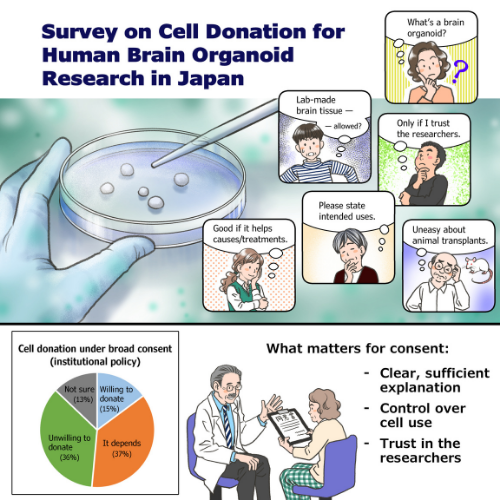
Japanese public show major reservations to cell donation for human brain organoid research New study argues standard forms of consent for cell donations would not be appropriate for this line of research A new study found that most Japanese citizens hesitate to donate their cells for brain organoid research under current “broad consent” systems. The research suggests adopting a project-specific consent model for ethically sensitive research topics. (Credit: Yukari Mishima) Research on human brain organoids (HBOs) is directly challenging how biobanks and biomedical institutes recruit volunteers. That is what a new study by Japanese researchers in Frontiers in Genetics concludes after finding that the Japanese public overwhelmingly rejects the common practice of broad consent when their donated cells could be used to create HBOs. This attitude jeopardizes recruitment and calls for an alternative form of consent that follows the project-specific consent model. Researchers can culture don
Ethics must keep pace with embryo research Author:Tsutomu Sawai Journal:Nature October 28, 2025 https://www.nature.com/articles/d41586-025-03502-w
Respect Without Romanticizing: Cultural Values, Parental Reasons, and Unproven Pediatric Treatments in East Asia Author:Ji Hyun Yang, Shu Ishida, Chie Kobayashi, Tsutomu Sawai, Ilhaku Lee Journal:The American Journal of Bioethics October 18, 2025 https://doi.org/10.1080/15265161.2025.2554803
Japanese scholars submit a nuanced view linking diverse disability experiences Researchers at Hiroshima University (Japan) have introduced a new philosophical framework—“conditional bad-difference view” (Conditional BDV)—to understanding ethically important featuresof disability. Published in the journal Bioethics , Conditional BDV offers a nuanced way to think about the relationship between disability and well-being, aiming to better reflect and respect the diverse experiences of disabled individuals. The Conditional BDV was developed in response to shortcomings in the two dominant philosophical perspectives for disabilities. The “bad-difference view” (BDV) holds that a disability is inherently detrimental to well-being, even in ideal situations without discrimination against disabled people. By contrast, the “mere-difference view” (MDV) considers a disability as ethically neutral in such nondiscriminatorysettings, just like race and gender. The novel Conditional BDV challenges this
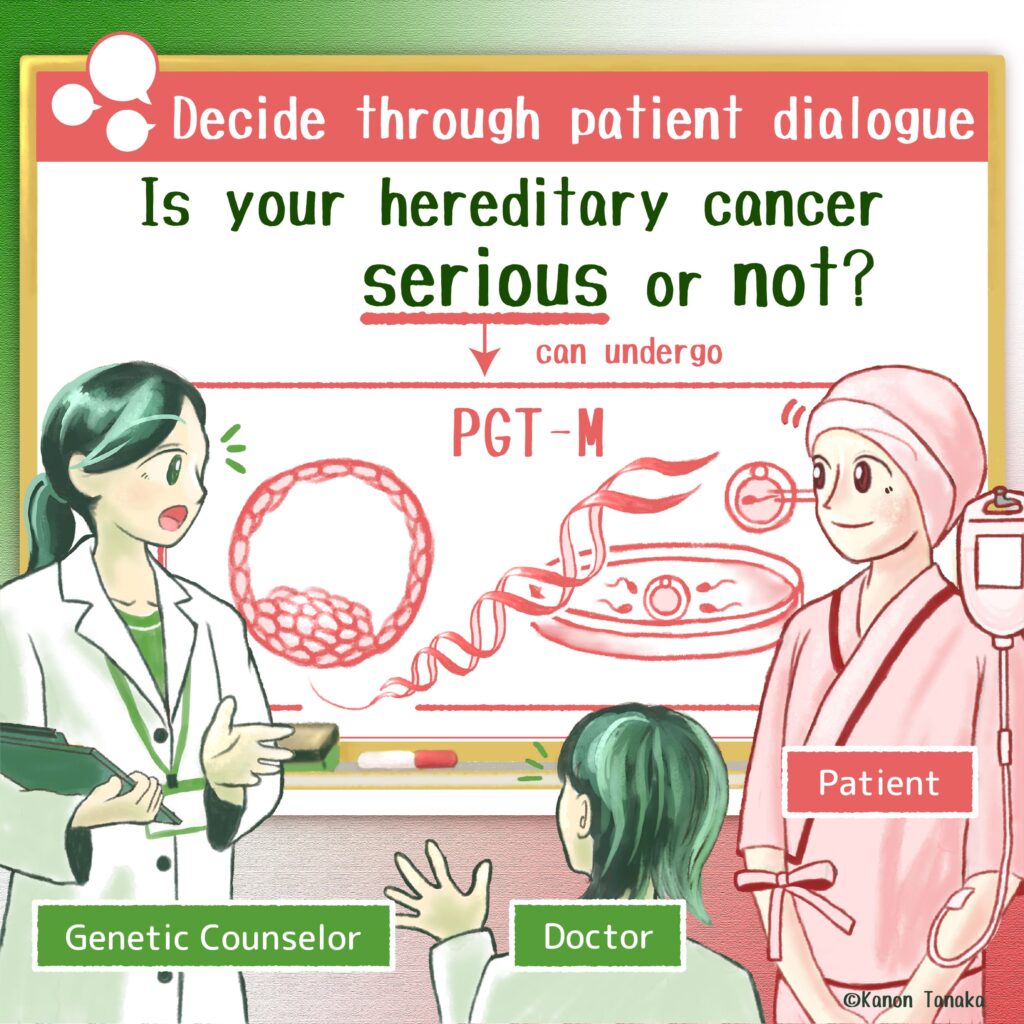
Team publishes correspondence article reevaluating ‘seriousness’ in genetic conditions Examines how patient voices impact decision-making A team of three Japanese researchers has conducted a survey of stakeholders to examine how patient voices impact decisions related to genetic testing for hereditary cancers. These stakeholders included patients, healthcare professionals, and ethicists attending a workshop in Hiroshima in early 2025. The correspondence is published in the European Journal of Human Genetics on March 15, 2025. There are differences of opinion in how to assess “seriousness” in genetic conditions. “In Japan, the seriousness of genetic disorders has traditionally been assessed using narrow medical criteria, limiting access to preimplantation genetic testing for monogenic diseases to only a small number of conditions. However, cases like retinoblastoma—which was only recognized as ‘serious’ after six years of patient advocacy—underscore the urgent need to incorporate sta
Human Stem Cell-Based Embryo Model Research: Ethics and Regulations Author:Chie Kobayashi, Shu Ishida, Tsutomu Sawai Journal:Methods in Molecular Biology October 4, 2025 https://doi.org/10.1007/7651_2025_668
When Ethical Principles Conflict: The Ethics of Genetic Confidentiality in Context Author:Rie Iizuka, Shu Ishida, Tsutomu Sawai Journal:American Journal of Bioethics September 18, 2025 https://doi.org/10.1080/15265161.2025.2543711
Japanese Attitudes Toward Cell Donation in Human Brain Organoid Research: Many Oppose Broad Consent Author:Masanori Kataoka, Mayu Koike, Tsutomu Sawai Journal:Frontiers in Genetics August 22, 2025 https://doi.org/10.3389/fgene.2025.1606923
Disability, Subject-Dependence, and the Bad-Difference View Author:Shu Ishida, Mitsuru Sasaki-Honda, Tsutomu Sawai Journal:Bioethics July 24, 2025 https://doi.org/10.1111/bioe.70012