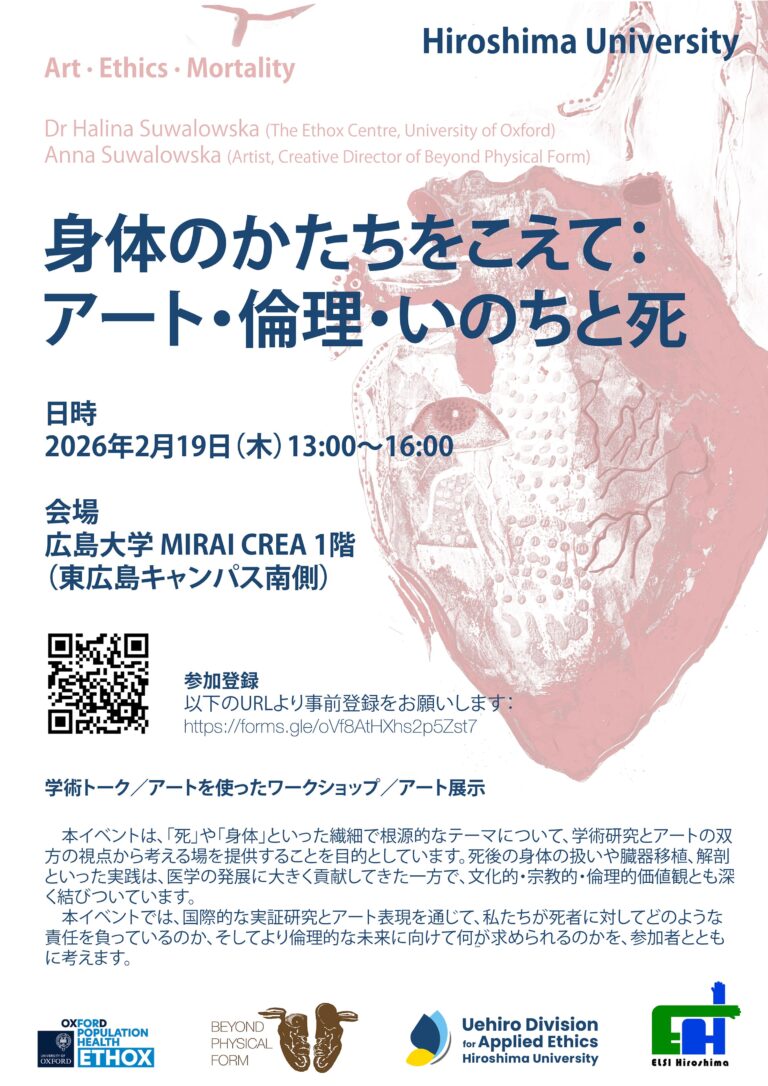
This event is a collaboration between social scientist Dr Halina Suwalowska, the Ethox Centre, University of Oxford (United Kingdom) and artist Anna Suwalowska (Poland, UK) founder of Beyond Physical Form , Professor Tsutomu Sawai from Hiroshima University, and hosted by the Uehiro Division for Applied Ethics and the Center for Collaborative Sciences at Hiroshima University (Japan).
Informed by Halina’s empirical research conducted across diverse international contexts on issues of death and the body in global health, this talk opens a space to reflect on what we owe to the dead and how they should be treated. It discusses the cultural sensitivities that shape our understanding of body, mind, and spirit. Practices such as postmortem examinations and organ transplantation save lives and advance medical knowledge, yet they are also shaped by religious, cultural, and moral beliefs. From historical practices of collecting human remains to contemporary debates about dignity and repatriation, participants are invited to reflect on the past and consider more ethical futures.
Emerging from her interdisciplinary projects at the intersection of art and science, Anna presents new perspectives through both the exhibition and the workshop. She introduces a creative methodology that brings audiences closer to complex ethical questions around mortality. The workshop, led by Anna,titled Beyond the Visible, guides participants through imaginative methods drawn from her artistic practice. Participants will also have the opportunity to experience an art exhibition by Anna Suwalowska that explores the intersection of art, science, and ethics, presented as part of Beyond Physical Form.
By placing the sensitive topic within an artistic setting, the event creates space for empathy and critical reflection, showing how art can bridge science, ethics, and lived experience. This approach resonates with broader efforts in experimental philosophy at the Uehiro Division for Applied Ethics to better understand how people actually think about ethical issues, while remaining attentive to the limits and responsibilities of using such perspectives.
Registration form is available in here (in Japanese).

1-7-1, Kagamiyama, Higashi-Hiroshima 739-8521 JAPAN
Uehiro Division for Applied Ethics
Graduate School of Humanities and Social Sciences, Hiroshima University